
If you’re measuring productivity in a cobot welding cell, arc-on time is one of the fastest ways to see what’s really happening. More arc time means more welds completed, and a clearer path to throughput and ROI.
Cobot welding can raise arc-on time compared to manual welding. But in many shops, arc-on time still levels off when changeovers, part fit-up, and setup work slow the cell down.
That’s where quick-change tables and fixture plates matter. They cut non-welding time so the cobot can spend more of the shift under arc.
Arc-On Time: What It Is and Why It Matters in Cobot Welding
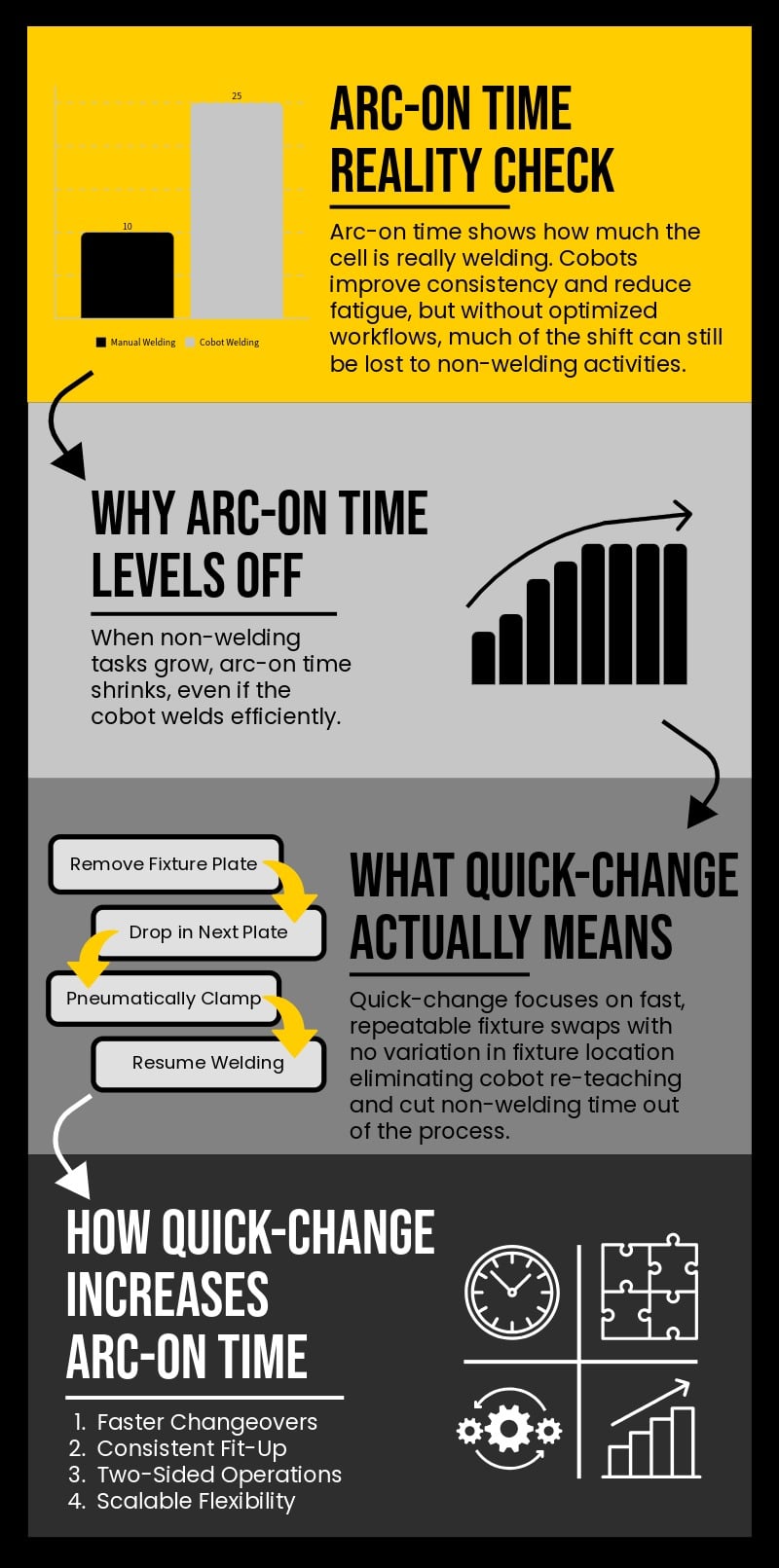
Arc-on time is the portion of time the welding arc is actively running and producing a weld. It excludes everything else, part fit-up, repositioning, changeovers, inspections, and downtime. Because it strips out non-welding work, arc-on time quickly shows whether the whole cell (not just the cobot) is running efficiently.
Manual Welding vs. Cobot Welding: A Realistic Look at Arc-On Time
Manual welding arc-on time often stays low because welders spend time on part handling, repositioning, fit-up adjustments, fatigue-related pacing, and downtime between welds.
As a result, many manual welding operations fall in the 10–12% arc-on time range, depending on part complexity and workflow.
By contrast, cobots improve arc-on time through repeatable weld travel, consistent motion, reduced variability, and less operator fatigue.
In many real-world cells, cobot arc-on time lands in the 20–40% range.
That improvement is meaningful. Still, it often surprises teams because it remains far below the theoretical capability of automation.
The reason is simple: the cobot may weld efficiently, yet the surrounding workflow may not be optimized.
Why Arc-On Time Levels Off in Many Cobot Cells
Many teams assume that adding a cobot automatically resolves productivity problems. In reality, arc-on time is often limited by everything except the robot.
Typical bottlenecks include:
- Long changeover times between parts
- Manual fixture removal and re-alignment
- Inconsistent part fit up
When a cobot sits idle while parts are loaded, fixtures are adjusted, or tooling is swapped, arc-on time suffers, even if the weld itself is fast and repeatable.
What “Quick-Change” Means in a Cobot Welding Cell
In welding context, quick-change means swapping fixtures and part setups fast and repeatably, with no variation in fixture location, so the cobot does not need to be re-taught each time.
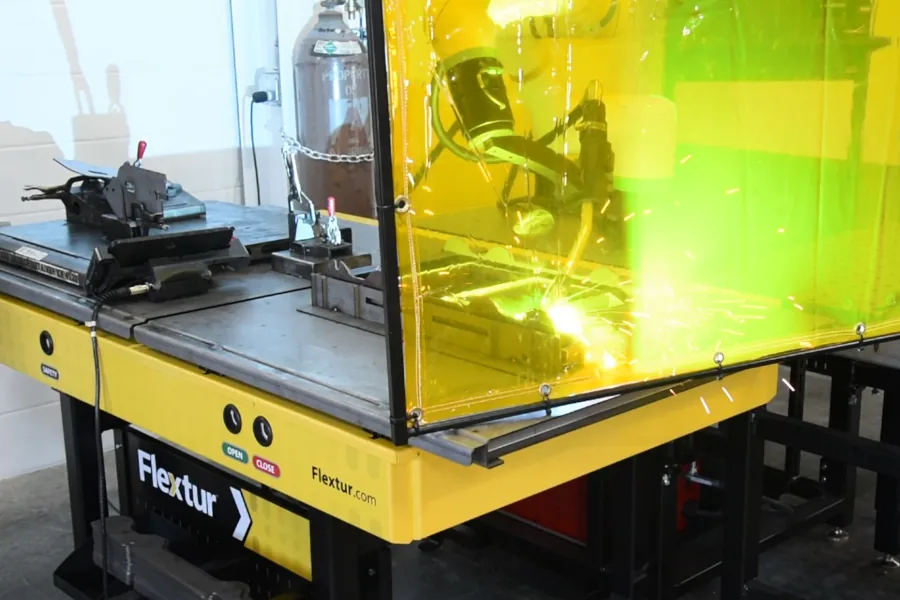
Flextur’s Cobot Quick-Change tables include:
- Quick-Change fixture plates for fast and efficient changeovers
- Dedicated fixture plates that are designed for specific parts to ensure consistent and precise fit up.
- Pneumatic clamping system that ensures fixtures return to the exact position for repeatable placement
- Two hand push button operation for operator safety
The goal is simple: reduce non-welding time so the cobot spends more of the shift under arc.
How Quick-Change Tables and Fixture Plates Increase Arc-On Time
When quick-change tables and fixture plates are integrated into a cobot cell, several productivity gains occur simultaneously:
- Faster Changeovers
Instead of tearing down a fixture and rebuilding it, operators can remove one fixture plate, drop in the next, and lock it into position. In many cases, changeovers that once took 30–60 minutes can drop to minutes.
- Improved Part Fit-Up Consistency
Dedicated fixture plates control part fit-up. They also reduce distortion and misalignment, which helps minimize rework and touch-ups. Because fit-up stays consistent, the cobot sees fewer stops and fewer corrections, so welding runs more continuously.
- Two-Sided Operations
2-Sided operations are one of the biggest contributors to higher arc‑on time in a cobot welding cell. Instead of the cobot waiting for the operator, work happens simultaneously.
With a properly configured quick‑change table, operators can load, unload, and stage parts on one fixture plate while the cobot welds on another. When the weld cycle finishes, fixtures are swapped quickly and repeatably, and the cobot goes right back under arc.
This approach eliminates one of the most common sources of idle time in cobot cells: the stop‑and‑wait cycle between welding and part handling.
- Scalable Flexibility
Quick-change systems help manufacturers run high-mix, low-volume parts efficiently. They also allow teams to add new products without rebuilding the cell and to standardize setups across multiple cobot cells.
The Result: Higher Arc-On Time Without Sacrificing Flexibility
When quick-change tables and fixture plates are implemented well, it’s not uncommon for cobot arc-on time to move beyond 40%, depending on part mix and workflow.
Instead of treating the cobot as the only solution, teams start treating the whole cell like a system, and performance improves.
In practice, these improvements are most sustainable when quick‑change capability is paired with a thoughtful cell design and a long‑term mindset. For example, Modine’s cobot welding journey shows how incremental improvements, focused on flexibility, repeatability, and operator support, can compound over time. Across a 365‑day implementation, Modine refined its fixturing, changeover approach, and overall cell layout to achieve measurable productivity gains without locking into inflexible automation.
Their experience reinforces a key takeaway: higher arc‑on time isn’t driven by the cobot alone, but by how well the entire welding cell is designed to support ongoing change.
Cobot Welding Increases Arc-On Time, But Cell Design Determines How Much
Cobot welding can improve arc-on time, but the cell design controls the ceiling.
Quick-change tables and fixture plates don’t just support the cobot; they help unlock its potential by reducing changeover time, improving fit-up, and enabling parallel work.
That way, manufacturers move closer to the productivity automation promises while keeping the flexibility that makes cobots appealing.
Want to See What’s Costing You Arc-On Time?
Talk with our team about your part mix, changeover process, and cell layout, and we’ll help you identify the fastest path to higher arc-on time with the right quick-change table and fixture approach.