

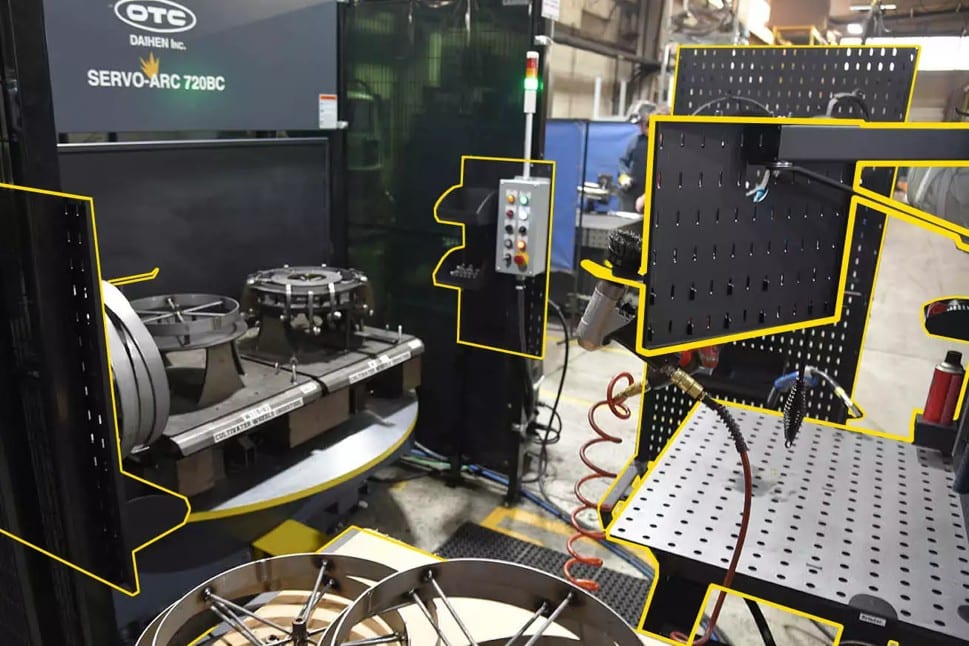
In a cobot welding cell, arc-on time is already on your radar, and your fixtures, programs, and changeovers are dialed in. At that point, productivity improvements come from a different place: keeping the entire cell running smoothly and predictably, shift after shift.
Because in a mature cell, performance is often less limited by the cobot and more by the supporting footprint: material flow, staging, tool access, lifting, and safety barriers that protect people without slowing the work.
So, the goal becomes less about “getting started” and more about sustaining high throughput: reducing delays, protecting consistent changeovers, and designing the cell so parallel tasks happen without interrupting the weld cycle.
In other words, the full footprint - tables, fixtures, barriers, material flow paths, storage, tool access, and lifting - determines whether an optimized cobot welding system stays optimized when real-world variability shows up (mix changes, part queues, rework, and shift handoffs).
What is an Optimized Cobot Welding Cell?
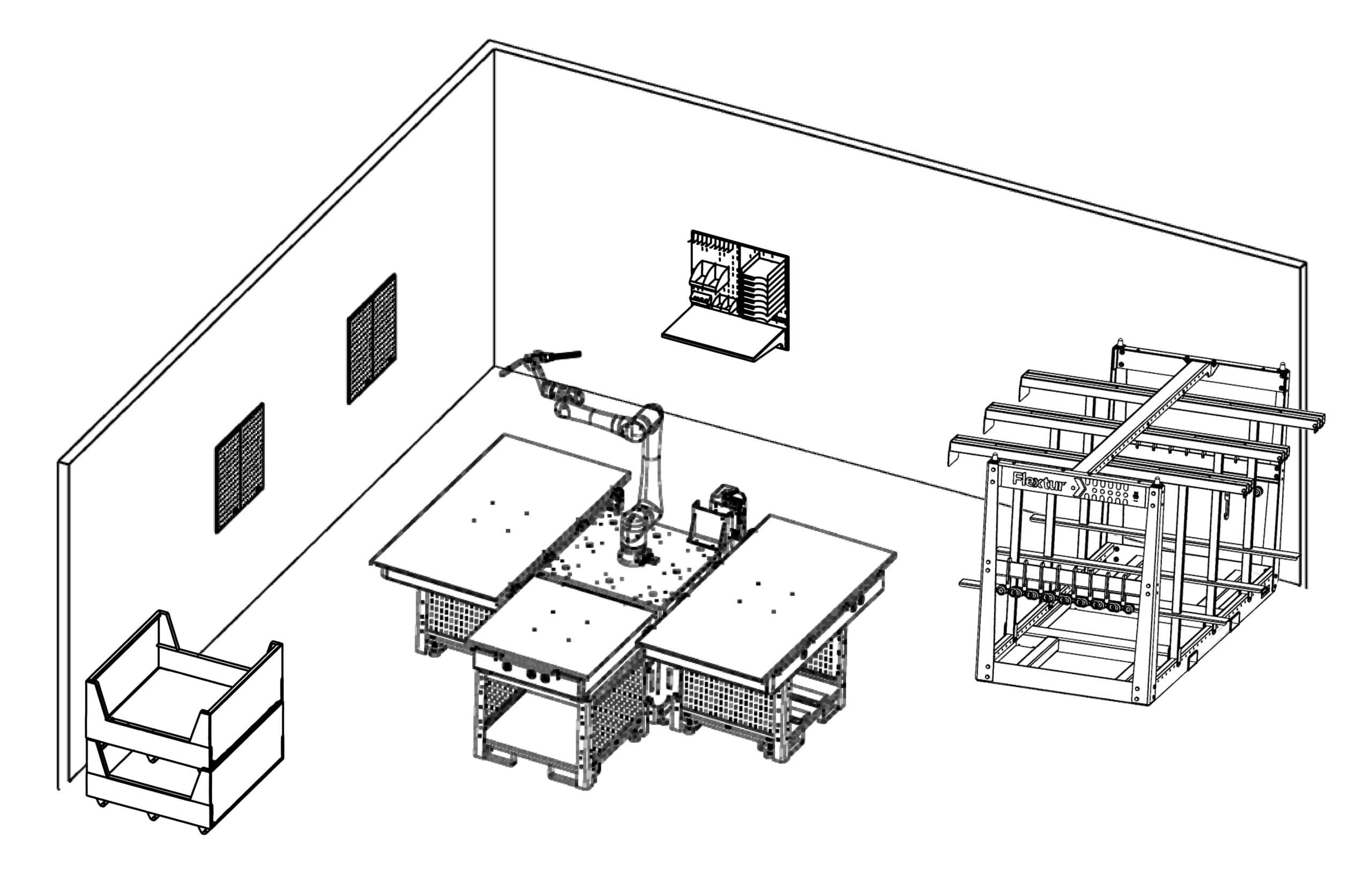
A Cobot Welding Cell is a System - Not a Single Piece of Equipment
Cobots are flexible by design. They help shops automate welding without committing to a rigid, high-volume line. That same flexibility is why the cell layout and standard work around the cobot matter so much. When the footprint is treated as an afterthought, the same issues tend to show up: operators spend more time walking and searching, load and unload zones become congested, and changeovers feel slower than they should. Safety barriers may restrict access, and fixtures often sit too far from where they’re needed. Each delay is small, but over a shift, they add up and quietly limit throughput.
Each one looks small in the moment. Over a shift, the minutes stack up, and arc-on time and throughput quietly level off. High-performing cobot welding cells treat everything inside the footprint as part of the process, not “extra stuff” bolted on later.
The Foundation: Quick-Change Tables and Fixture Plates
Quick-change tables and fixture plates are the backbone of a productive cobot welding cell. They lock in repeatable part location and let operators move job-to-job without tearing down and rebuilding setups.
Related: Arc-on time is one of the clearest signals of whether a cell is truly flowing, especially when job mix and changeovers are frequent. (Cobot Welding Arc-On Time + Quick Change Tables)
They also define the workflow:
- Where parts enter and exit the cell
- How operators move during changeovers
- How fixtures are staged and stored
- How parallel work can occur
When tables are designed as part of the system, you get predictable flow instead of reactive firefighting.
Weld Barriers and Walls: Safety Without Killing Flow
Weld barriers and walls are often treated as a compliance checkbox. In practice, barrier placement can either protect people and keep work moving, or it can turn a good cell into a daily workaround. Well-designed weld barriers do more than meet safety requirements. They protect operators while still allowing easy access, define clear load and unload zones, and help organize material flow within the cell. Poor placement forces operators to walk around the cell instead of working through it, more steps, awkward reaches, and more time lost. Plan barriers alongside tables and fixtures and you can improve safety and access at the same time.
Overhead Cranes and Lifting: Keep Parts Moving, Not Waiting
In a lot of cobot welding cells, part handling becomes the hidden bottleneck.
If large or awkward weldments require lifting, missing (or poorly placed) crane coverage can:
- Delay changeovers
- Create unsafe manual handling
- Force operators to wait before loading
When lifting is designed into the layout:
- Fixtures can be staged ahead of time
- Heavy parts move smoothly in and out
- Operators stay focused on welding, not wrestling parts
Design crane coverage into the cobot cell footprint early. Retrofitting after ramp-up is almost always slower, more expensive, and more disruptive than doing it right up front.
Fixture Storage Racks: Changeovers Start Before the Cobot Stops
Fast changeovers depend on prep. Prep only works when fixtures are stored:
- Close to the cobot
- Clearly identified
- Easy to access
- Easy to return
With fixture storage located inside or adjacent to the cell, operators can pre-stage the next job, reduce unnecessary walking, and keep fixtures organized and protected between runs. This is a simple lean principle: push as much work as possible outside of robot downtime. It’s a simple approach, but it consistently improves throughput.
Toolboards: Eliminate Delays That Add Up
Tool access gets overlooked because it rarely feels like the “big problem”, until you time it.
If operators have to repeatedly:
- Walk to find clamps or tools
- Search through drawers
- Borrow tools from nearby stations
Those seconds turn into minutes. Minutes turn into lost capacity. Toolboards inside the cell keep tools visible and standardized, reducing wasted motion and supporting more consistent changeovers, especially in high-mix environments where repeatability drives performance. In high-mix welding, repeatability is the real accelerator.
Design For Flow, Not Just Fit
A common cobot welding cell mistake is designing for space efficiency instead of process flow.
Teams often optimize the cobot and tooling, then compress the footprint to “make it fit.” The result is extra steps, bottlenecked staging, and awkward changeovers. A little more space in the right places typically pays back in throughput.
High-performing cells are designed as systems, where layout supports consistent execution between weld cycles, not just the weld itself. Staging, walking, lifting, and changeovers either flow smoothly or create stop-and-go delays that limit arc-on time.
Effective layouts tend to:
- Provide clear entry and exit points
- Separate welding, staging, and storage
- Allow operators to work without crossing paths
- Support parallel tasks during weld cycles
- Keep tools, fixtures, and materials within reach
Throughput isn’t driven by any single component. It’s the combination - tables, fixtures, barriers, storage, tooling, and layout that determines how often the cobot is able to weld.
In well-designed cells, that structure makes performance easier to sustain:
- Higher arc-on time
- Faster, repeatable changeovers
- Better safety and ergonomics
- More predictable throughput
The cobot may execute the weld, but the cell design determines how often it gets the chance.
See one of Flextur's welding cells in action >> Flextur's Optimized Cell
How Flextur Can Help
At Flextur, many of our cobot welding solutions started the same way our products always have, by solving challenges in our own manufacturing operations first.
Today, we help manufacturers design high‑performing welding cells by supporting the full footprint, including:
- Welding tables and quick‑change fixture plates
- Custom fixtures for repeatability and accuracy
- Weld barriers and walls designed for safety and access
- Fixture storage racks and material staging solutions
- Toolboards and point‑of‑use tool access
- Integrated lifting and crane support
If you’re refining an existing cobot welding cell, or planning the next one, our team can help you pressure-test the footprint: access, flow, staging, safety, and repeatability.