

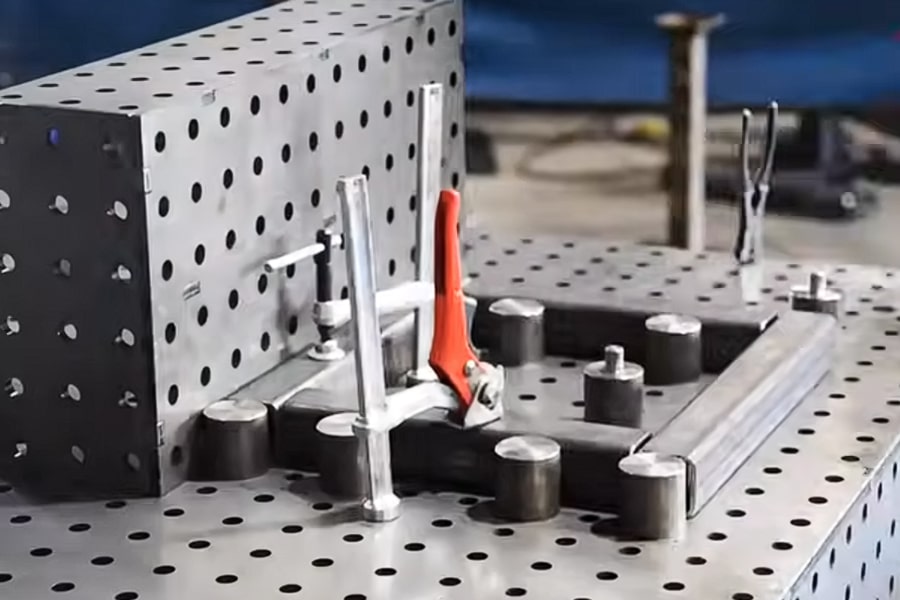
A flat steel table has no built-in way to locate or hold parts, so welders rely on soapstone marks, squares, and clamps improvised on the fly. A modular pin-and-clamp welding table, typically a tabletop with a 2-inch hole or grid pattern plus locator pins and clamps, lets you position parts accurately and repeatably, cutting setup time and rework. It's usually the first upgrade a growing weld shop makes, and it's also the foundation that later supports cobots and custom fixtures.
Every Shop Starts Somewhere: The Flat Table Problem
Almost every welder's first setup looks the same: a flat piece of steel, a tape measure, a square, and whatever clamps are on hand. It works, and it's cheap. But it doesn't scale.
On a flat table, every part gets located from scratch. The second piece never sits exactly like the first. Small variations creep in, an eighth of an inch here, a degree of skew there, and on parts that need to fit downstream assemblies, that variation turns into rework, wasted material, and inconsistent welds. New welders take longer to get up to speed because there's no repeatable reference point to teach them. Experienced welders spend real time on setup instead of arc-on time.
None of that shows up as a single line item on a P&L. It shows up as slower throughput, more scrap, and welds that don't pass inspection because the setup made it difficult to get right. That's the hidden cost of a flat table.
What a Modular Pin-and-Clamp Welding Table Actually Does
A modular welding table replaces the flat, featureless surface with a tabletop engineered with a repeating hole or grid pattern, commonly a 2-inch grid, paired with locator pins, stops, and clamps that drop into that pattern anywhere on the table, not just along the edges.
That grid is the whole point. Instead of measuring and marking every setup, a welder sets locator pins and clamps to the part once, and every identical part after that lands in the same spot. Squareness and alignment come from the table, not from operator skill alone. That's a meaningful shift: it means a less experienced welder can produce a consistent, accurate weld on their first day on a new job, because the table is doing part of the work that used to depend entirely on the person.
Flextur build these tables with a robust strut system under the tabletop for rigidity, so the surface holds its accuracy under repeated clamping and welding heat, an important detail, since a grid pattern is only useful if it stays true over years of production.
Fixturing Kits: Modular Fixturing Without a Custom Build
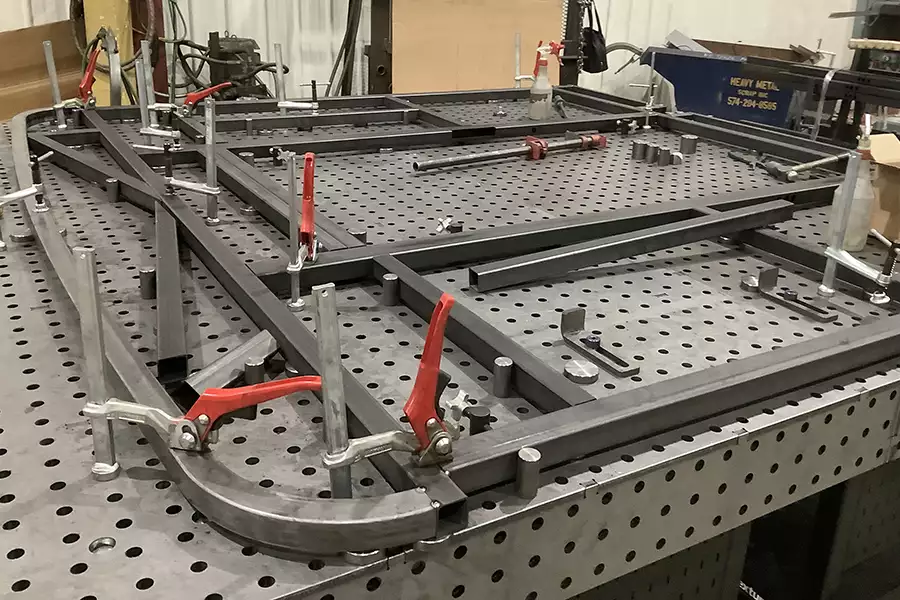
The next step up from a bare modular table is a fixturing kit, a set of pins, clamps, stops, and blocks sized to drop into the table's grid pattern. These kits typically come in a few sizes (Flextur, offers kits ranging from around 27 pieces up to nearly 100), and welding tables are often sold as a combo with a kit already included.
The advantage of a kit over a fully custom fixture is flexibility. A welder can reconfigure the pins and clamps for a new part in minutes, without waiting on an engineered fixture or tying up the table to one job. For shops running mixed, lower-volume work, that flexibility often matters more than a purpose-built fixture would.
Signs Your Shop Has Outgrown a Flat Table
A few signals tend to show up before a shop makes the switch:
- Setup time is starting to rival weld time on repeat jobs.
- New hires take weeks, not days, to produce consistent work.
- Rework or fit-up issues trace back to inconsistent part location, not welding technique.
- The shop is quoting more repeat or family-of-parts work, where a repeatable setup pays for itself quickly.
- Someone is already improvising fixturing - clamps welded to the table, wood blocks, etc. - which is usually a sign the shop needs real fixturing, just not yet a custom one.
If two or three of those sound familiar, a modular table with a fixturing kit is typically the next logical step, not a full custom fixture build.
Where This Leads
A modular pin-and-clamp table with a fixturing kit solves the location and repeatability problem. It doesn't automate anything by itself, but it happens to be the exact foundation that cobot welding is built on. Once a shop has a stable, gridded welding surface, adding a cobot arm becomes a matter of mounting hardware, not rebuilding the workstation from scratch. We'll cover that transition, and the stages shops move through as they scale up cobot welding, in the next post.