

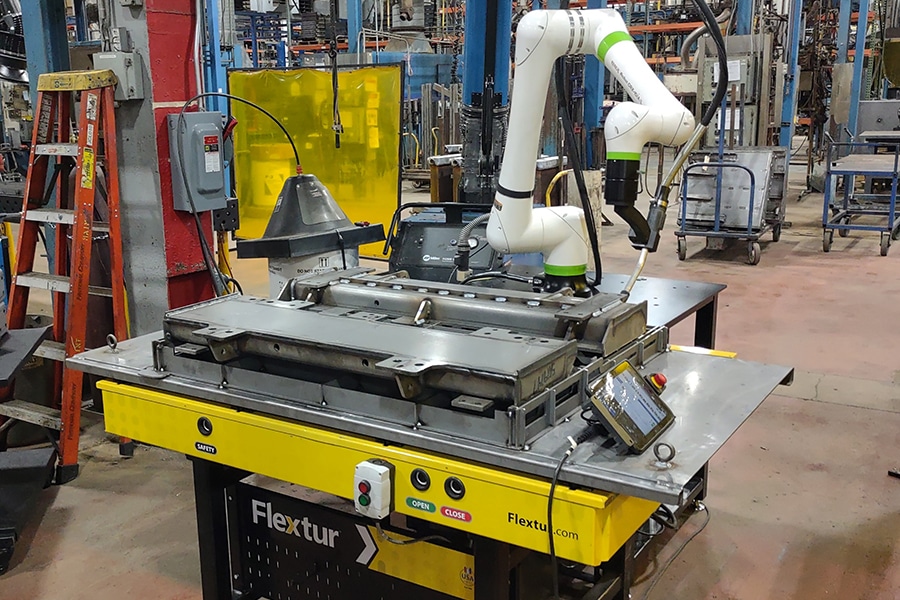
A dedicated custom fixture is usually the right call for a stable, high-volume part - it's built to hold that part precisely, load quickly, and pay for itself fast. For a lot of shops, that fixture is exactly what makes a cobot cell worth the investment in the first place. The question worth asking isn't whether that fixture was the right decision. It's what a shop does next, once that success brings in a second part to run.
The Job That Showed Up Sooner Than Expected
Picture the moment: a customer calls wanting to add a new part. Similar process, similar volume, different geometry. The shop has a cobot cell running well, built around a fixture that's been doing exactly what it was designed to do.
On paper, taking the new job should be an easy yes - the cobot has the capacity, and the shop has already proven it can run precision work at volume. The only open question is fixturing: the current fixture is dedicated to the part it was built for, so the new part needs its own path onto the table.
That's not a flaw in the original fixture. It's a sign the shop's capability outgrew what any single fixture was ever meant to cover on its own.
Why This Is a Growth Signal, Not a Design Problem
A custom fixture earns its cost back on the job it was built for - that's the whole point of building one instead of relying on general-purpose pins and clamps. Nobody sets out to build "too much" fixture; the fixture does exactly what it should for as long as the shop is running one steady part.
The moment worth paying attention to is different: it's the moment a shop's part mix starts to diversify - more repeat jobs, more varied geometry, more customers who like what the first job proved the cell could do. That's success creating a new question, not a fixture creating a problem.
The Decision Point: What a Second Part Actually Requires
Before assuming a new part means duplicating the whole setup, it's worth separating two different questions:
- Does the new part need its own dedicated, custom-designed fixture? In most cases, yes - just like the first part did, if it's going to run at real volume with the same precision.
- Does it need its own table, pedestal, and cobot too? Not necessarily - that depends on whether the table can support more than one fixture, not on whether the fixture was worth building.
Keeping those separate matters, because the answer to the first question is almost always "build the fixture" - a repeat part deserves the same precision the first one got. The answer to the second question is where a shop has real options.
What to Weigh Before Adding a Second Table
A few questions help sort out which path fits:
- Is this new part the start of a pattern, or a one-time request?
- How many more part families are likely to show up over the next 12-24 months?
- Would the shop rather invest in a second cobot, full table and pedestal, or in a way to run more than one dedicated fixture on a single table?
For a shop that expects to stay focused on one steady part, a straightforward second table may be the simplest answer. For a shop that's starting to see more variety - the kind of variety that comes from winning more of the business a strong cobot cell can attract - there's a way to keep building dedicated fixtures for each new part without duplicating the table underneath them. Running the numbers on either path side by side, using a payback analysis, usually makes the better fit clear.
Where This Leads
A docking station and a quick-change table and fixture plates don't replace a custom fixture - they give it a second life alongside the next one. The original fixture becomes a plate; the new part gets its own plate, built with the same precision and dedication as the first. The table and cobot support both, swapping between them in less time than it used to take to position the original fixture. See how that changeover speed shows up in arc-on time across a shift. It's not a fix for something the first fixture did wrong. It's what a shop adds once building one great fixture turns into building a second.