

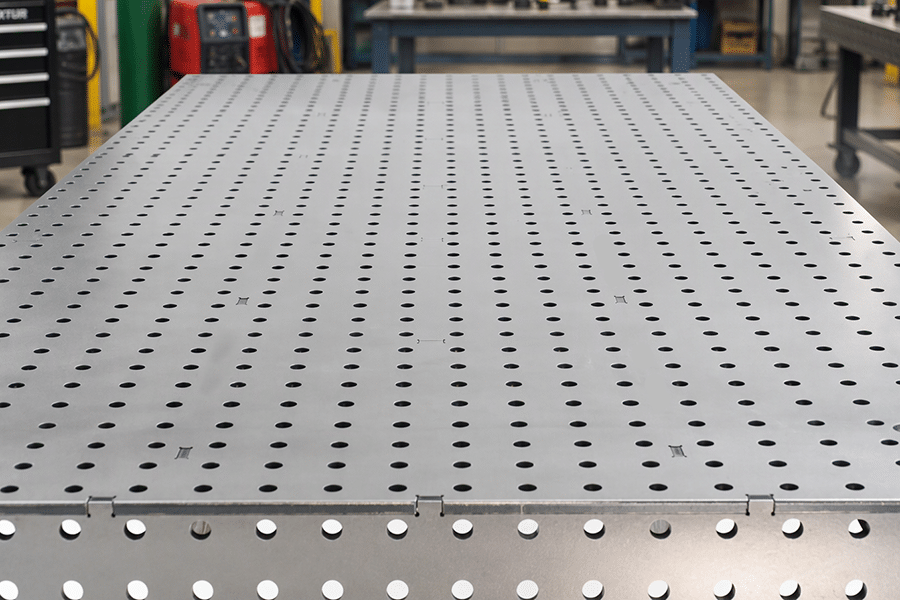
A modular welding table is one of the few tools in a shop that can keep earning its keep for decades. Its value comes from one thing: a flat, true surface with holes that locate parts in the same place every time. When either one drifts, setups take longer, fixtures stop repeating, and a cobot program that ran smoothly last month starts needing touch-ups.
The good news is that keeping a table accurate doesn't take much. It mostly comes down to a few habits that keep it clean, protected, and checked.
The short answer: To keep a modular welding table accurate, wipe off spatter and debris after each shift, clean and lightly protect the holes and surface every week, keep the table level, and check flatness at least once a year. Avoid grinding, hammering, or cutting directly on the work surface. Those three habits cause most of the damage that throws a table out of tolerance.
Why do welding tables lose accuracy?
Most tables don't wear out. They get worn down by small, repeated habits. These are the usual causes:
- Spatter build up. Even on a spatter-resistant Nitride + surface, spatter left to pile up creates high spots. Parts and fixtures then sit a few thousandths off.
- Debris in the holes. Grinding dust, slag, and dried anti-spatter collect in the holes. Pins and clamps stop seating fully, so the locating accuracy the table was bought for is lost.
- Grinding and impact. Taking a grinder to the surface removes material unevenly. Hammering parts into place on the top can dent the surface and the edges of the holes.
- Heat damage. Torch cutting, plasma cutting, or a poor ground connection can leave arc marks and local heat distortion.
- Rust. Humid shops, wet parts, and coolant can cause the worksurface to rust, especially around the holes where moisture sits.
- An uneven floor. A table that isn't level, or that rests unevenly on its legs, can twist over time under heavy loads. That reads as a flatness problem even when the top itself is fine.
A simple welding table maintenance checklist
A routine that's easy to remember is easier to keep. Here's one that fits most fabrication shops:
| How Often | What To Do | Why It Matters |
|---|---|---|
| Every Shift | Brush or scrape off loose spatter and slag. Blow out or vacuum debris from the holes in the work area. | Keeps high spots from forming and lets pins and clamps seat fully. |
| Every Shift | Put clamps, pins, and stops back in their storage spots. | Accessories left on the top get knocked around, dropped, and lost. |
| Weekly | Clean the full surface with a non-abrasive pad. | Catches buildup before it bonds to the surface. |
| Weekly | Apply a light rust inhibitor if the shop is humid or parts come in wet. | Rust build up can affect flatness, especially around fixture holes. |
| Monthly | Inspect clamps, pins, and fixture blocks for burrs, spatter, or wear. Clean or replace them. | Worn accessories cause as much locating error as a worn table. |
| Monthly | Check that the table is level and resting evenly on all legs or casters. | An uneven base can twist the frame under load. |
| Yearly | Check flatness across the full surface (see below). | Confirms the table is still within tolerance for precision and cobot work. |
For a cobot cell, tie the weekly cleaning to an existing routine, like a Friday wipe-down or a fixture plate changeover. That way it actually happens.
How to check welding table flatness
You don't need a metrology lab to spot-check a table. A precision straightedge and a set of feeler gauges will tell you most of what you need to know.
- Clean the surface completely. Any spatter or debris will throw off the reading.
- Level the table first. Use a machinist's level and adjust the leveling feet or casters until the table sits evenly on the concrete floor. Often time this is why the surface appears to be uneven.
- Lay the straightedge across the top. Check lengthwise, crosswise, and on both diagonals, so you cover the corners as well as the middle.
- Slide feeler gauges under the straightedge. Note the thickest gauge that fits anywhere along each line.
- Compare against the table's rated flatness. Write down the readings and the date so you can see whether anything changes year to year.
If a reading is out of tolerance, check the base and floor before blaming the top. Re-leveling fixes more "flatness" problems than most people expect.
Caring for the holes, clamps, and fixturing accessories
The holes are what make a modular table modular. They're also where trouble hides.
- Use a bore brush, not a drill bit. A nylon or brass bore brush clears debris without scoring the hole. Never ream or drill out a hole to make a pin fit.
- Keep spatter out of unused holes. In a high-spatter area, hole plugs or a quick blast of air at the end of the shift keep the holes clean.
- Seat pins by hand. If a pin or clamp needs force to go in, something is in the way. Clean the hole before going any further.
- Treat accessories like gauges, not scrap. Clamps, stops, squares, and fixture blocks locate parts. A burr on a stop is a burr on every part it touches.
- Store accessories off the table. A wall rack, mobile toolboard, or nearby cart keeps clamps from getting knocked around and gives every piece a home, which is the same idea behind a 5S workstation.
Common welding table maintenance mistakes
- Grinding spatter off the top. A grinder takes off spatter and table at the same time. Use a scraper or a non-abrasive pad instead.
- Using the table as an anvil. Use a dead-blow hammer on the part or the fixture, never directly on the work surface.
- Cutting on the table. Torch and plasma cutting belong on a cutting table, not a precision fixturing surface.
- Careless grounding. Clamp the ground securely to the table or the part. A loose ground can arc and pit the surface.
- Overloading one spot. Spread heavy parts and fixtures across the surface and stay within the table's rated load capacity.
- Skipping the check. Without a yearly flatness reading, you won't know whether a recurring fit-up problem comes from the table, the fixture, or the part.
A few minutes a week, years of accuracy
A welding table doesn't ask for much. A clean surface, clear holes, a level base, and a yearly check will keep it doing the job it was built for, one setup after another. If you have questions about caring for your table, our team is glad to help.