

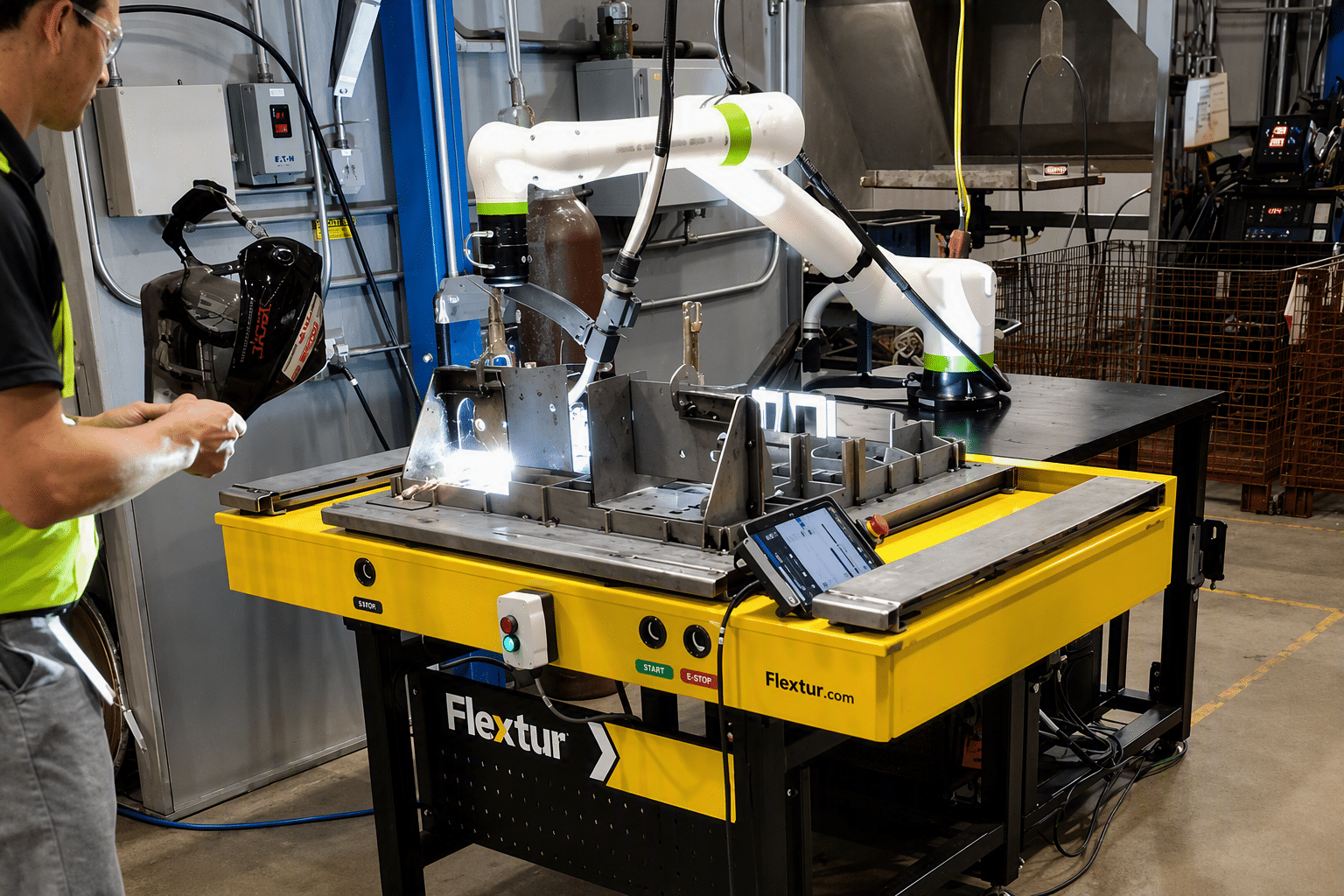
Every shop's automation story starts the same way: a welder, a piece of steel, and a job to get done. Most shops move through the same five stages on the way from there to a fully automated cell - a flat table, a modular pin-and-clamp table, a custom fixture, a cobot, and finally a quick-change system that lets one cell run more than one part. Here's what Dale's journey looks like. Although Dale is fictional, the journey isn't. It's assembled from the shops and welders we've worked with over the years.
Stage One: The Flat Steel Table
Dale had been welding for six years before anyone handed him anything but a flat piece of steel, a tape measure, and a square.
It was honest work. Measure and mark the centerline, square it up, tack it, weld it, move to the next one. He was good at it - good enough that the supervisor kept giving him more of it.
But the second part never matched exactly like the first. An eighth of an inch here. A degree off there. Nothing that failed inspection, but enough that the fit-up crew downstream had some trouble with it, and enough that Dale spent as much time squaring up a part as he did welding it.
Stage Two: The Grid Changes Everything
The downstream fit-up issues eventually became too great to ignore. No one blamed Dale for this, but now the supervisor had a number for what the flat table was costing them. So, they invested in a pin & clamp welding table with a flat 2" grid pattern of 16mm holes which allow locator pins, and clamps to drop in anywhere on the surface.
The first time Dale set pins and placed the parts, tacked and welded, he was able to run the second one right away - no tape measure, no square, no guessing - same spot, every time.
That's the shift a modular pin-and-clamp table makes: the table does the locating now, not the welder's eye. New welders started producing clean welds their first week instead of their first month. Dale's setup time dropped enough that he noticed the difference in his own arc time by lunch.
This table was about to become the foundation for everything that came next.
Stage Three: A Fixture Built for the Job
A year later, the shop landed a repeat job - same bracket, thousands of them, quarter after quarter. The locator pins and clamps worked, but resetting them every batch was slower than it needed to be for a part that never changed.
So the shop purchased a fixture welded specifically for that bracket. It cut Dale's setup time to almost nothing. Every part landed exactly where the last one had. For the first time, Dale was not only able to weld faster but with accuracy and precision.
Stage Four: The Cobot Shows Up
The bracket job kept growing and growing. Repeat work is exactly the kind of problem a cobot is built to solve. So, the shop invested in a cobot and a pedestal that attached to the same table he was already using - same grid, same custom fixture, no rebuild required. Dale spent some time teaching it the weld path, and soon, it was running the bracket on its own while Dale handled fit-up and loaded the next part.
It felt like the finish line. Dale figured this was as far as the journey went - a cobot, a fixture, a table, running one job clean.
The Job That Almost Got Turned Down
Then a new part came in. Different bracket, same process, same volume the cobot could easily handle - except the fixture Dale built was built for the old part, not this one.
Dale went to the shop lead with the good news and the catch in the same breath: they could win this job, but only if they pulled the fixture that was still running fine on the current one, or bought a second table, cobot and built a second fixture from scratch.
That was the moment it stopped being a welding problem and became a business problem - the exact ceiling a dedicated fixture eventually runs into, no matter how well it was built.
Stage Five: One Table, Any Part
The shop didn't buy a second table or another cobot. Instead, they invested in a table that allows them to continue growing while retaining their accuracy and efficiency. They added a docking station and a quick-change table. That's the system Flextur builds - and the stage most shops call us about, because the quick-change fixture plates have to hold the same accuracy the old fixture did.
The old bracket fixture became a plate. The new part got its own plate, built to hold that one part perfectly. The difference was what happened between jobs: Dale was able to release one plate and lock in the other one, in just a few minutes.
For the first time, saying yes to a new part didn't mean saying no to the one already running.
The Table Dale Started On Isn't the One He's Standing At Now
Same shop floor. Same welder, further down the road. What changed wasn't Dale's skill - he was a good welder the whole way through, from the flat table to the Quick-Change Table. What changed was how much of the accuracy, repeatability, and flexibility came from the table itself instead of resting entirely on him.
Every shop moves through these stages at its own pace, and plenty of shops are running well at any one of them. But if the fixture on your table is starting to decide which jobs you can and can't take, that's usually the sign the next stage is worth a look. The cobot was never the constraint. The fixture underneath it was.
Not sure which stage you're at?
Here's the test: if two or more parts are competing for the same fixture, you're at the stage before quick-change. That's the point where a docking station and a Quick-Change Table should be considered for future growth.